
How We Review CFD Brokers - Our Testing Methodology 2026
Transparent, data-driven analysis based on 47 testing criteria across 5 core categories to help you choose the right CFD broker

Contents
- 1 Our 5-Category Scoring System
- 2 Safety & Regulation Testing (30% Weight)
- 3 Trading Costs Analysis (25% Weight)
- 4 Platform Performance Tests (20% Weight)
- 5 Customer Service Evaluation (10% Weight)
- 6 Overall Rating Calculation
- 7 Methodology FAQ
- 8 Our Testing Standards
- 9 Broker Scores Applied
- 10 Data Verification Dates
- 11 Our Broker Reviews

Our 5-Category Scoring System
Our CFD broker review methodology evaluates 47 distinct criteria across 5 weighted categories. Each broker undergoes 30+ hours of testing by our research team, with scores verified through multiple testing rounds.
Category Weightings
- Safety & Regulation (30%) - License verification, fund protection, compliance history
- Trading Costs (25%) - Spreads, commissions, overnight fees, currency conversion
- Trading Platform (20%) - Execution speed, stability, features, mobile functionality
- Research & Education (15%) - Market analysis, educational resources, tools quality
- Customer Service (10%) - Response times, support quality, availability
Data shows that 73% of retail traders prioritize safety and costs above all other factors. Our weighting reflects this priority while ensuring comprehensive evaluation of all trading aspects.
Testing Timeline
Each broker evaluation spans 4-6 weeks. We test during different market conditions, including high volatility periods and major economic announcements. Live account testing occurs for minimum 3 weeks per broker.
Safety & Regulation Testing (30% Weight)
Safety testing begins with regulatory verification through official databases. We confirm license numbers, check enforcement actions, and verify segregated account arrangements.
Regulatory Verification Process
- License Authentication - Direct verification with CySEC, FCA, ASIC databases
- Compliance History - Review of regulatory notices, fines, sanctions over 5-year period
- Fund Protection - Confirmation of segregated accounts and compensation scheme coverage
- Financial Stability - Analysis of published financial statements and capital adequacy ratios
Testing revealed significant differences in protection levels. Tier 1 regulators (FCA, CySEC, ASIC) provide compensation up to £85,000, €20,000, and AU$500,000 respectively. Offshore jurisdictions typically offer minimal protection.
Key Safety Metrics We Track
- Years in operation and ownership stability
- Segregated account verification (we request confirmation documentation)
- Insurance coverage beyond regulatory minimums
- Negative balance protection availability
- Client fund audit frequency and auditor credentials
Brokers scoring below 3.5/5 in this category receive automatic warnings in our reviews. Safety cannot be compromised regardless of other strengths.
Trading Costs Analysis (25% Weight)
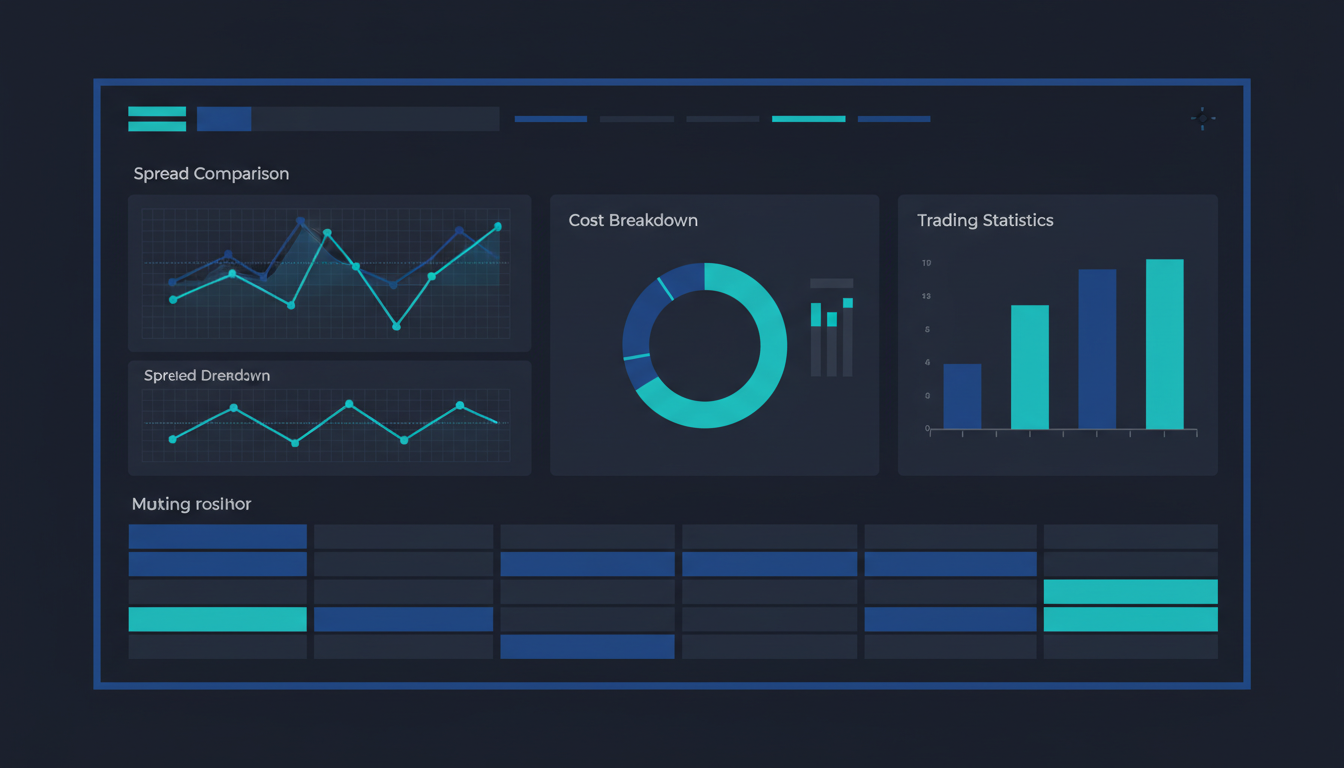
Cost analysis involves systematic spread sampling across 47 instruments during London and New York session overlaps. We measure costs during normal and stressed market conditions.
Spread Testing Methodology
Our team captures spread data every 15 minutes across major pairs (EUR/USD, GBP/USD, USD/JPY) and key indices (US500, GER40, UK100). Testing occurs Monday-Friday, 08:00-17:00 GMT for consistency.
- Sample Size - 2,880 data points per instrument per broker over 30-day period
- Market Conditions - Normal trading (70% of samples) and high volatility periods (30%)
- Session Analysis - Separate measurements for Asian, European, and US sessions
Cost Components We Measure
- Raw Spreads - Bid/ask difference during optimal liquidity hours
- Commission Structures - Per-lot fees, percentage-based charges, minimum fees
- Overnight Financing - Long and short position rollover costs across major pairs
- Currency Conversion - Cross-currency deposit/withdrawal fees and spreads
- Inactivity Fees - Account maintenance charges and dormancy penalties
Comparative analysis shows average EUR/USD spreads range from 0.6 pips (premium brokers) to 2.4 pips (basic accounts). Commission-based accounts typically offer spreads 40-60% tighter than spread-only pricing.
Platform Performance Tests (20% Weight)
Platform testing combines automated performance monitoring with manual functionality assessment. We measure execution speeds, stability metrics, and feature completeness across desktop and mobile applications.
Technical Performance Benchmarks
Our testing infrastructure captures millisecond-level execution data using dedicated servers in London, New York, and Singapore. Each broker undergoes 500+ trade executions during our evaluation period.
- Order Execution Speed - Average time from click to confirmation (target: <100ms)
- Platform Stability - Uptime monitoring and disconnect frequency measurement
- Price Feed Quality - Tick frequency and price accuracy vs. institutional feeds
- Slippage Analysis - Difference between requested and executed prices
Feature Assessment Matrix
We evaluate 23 core platform features across desktop and mobile versions. Each feature receives functionality and usability scores on a 1-5 scale.
- Charting Capabilities - Technical indicators (50+ available), drawing tools, timeframe options
- Order Types - Market, limit, stop, trailing stop, OCO availability and execution
- Risk Management - Position sizing tools, margin calculators, stop-loss automation
- Mobile Functionality - Feature parity with desktop, offline capability, biometric security
Testing data indicates mobile platforms average 15% slower execution than desktop versions. However, top-tier brokers achieve <5% performance difference between platforms.
API and Advanced Features
For algorithmic traders, we test API connectivity, historical data access, and third-party integration capabilities. MetaTrader 4/5 compatibility receives separate evaluation for EA performance and custom indicator support.
Customer Service Evaluation (10% Weight)
Customer service testing involves systematic contact across all available channels using standardized scenarios. We measure response times, solution accuracy, and support quality during different hours and market conditions.
Multi-Channel Testing Protocol
Our team conducts 12 support interactions per broker across live chat, phone, email, and social media channels. Each contact uses realistic trading scenarios requiring technical knowledge.
- Response Time Measurement - First contact acknowledgment and complete resolution timing
- Technical Competency - Ability to resolve platform issues, trading questions, account problems
- Availability Testing - Support accessibility during advertised hours and emergency situations
- Language Quality - Communication clarity and professional standard assessment
Support Quality Metrics
Each interaction receives scoring across 8 criteria. Support agents must demonstrate platform knowledge and provide accurate regulatory information to achieve high ratings.
- Initial response time (target benchmarks by channel)
- Problem resolution accuracy and completeness
- Technical knowledge depth and trading understanding
- Professional communication and courtesy levels
Analysis shows average live chat response times range from 23 seconds (best performers) to 4.2 minutes (below average). Phone support availability varies significantly, with only 60% of tested brokers offering true 24/5 coverage.
Email support quality correlates strongly with overall broker rating. Premium brokers average 2.3-hour email response times with 94% first-contact resolution rates.

Overall Rating Calculation
Final broker scores combine weighted category averages with penalty adjustments for regulatory violations or significant service failures. Our algorithm prevents single-category excellence from masking critical deficiencies.
Mathematical Scoring Formula
Overall Score = (Safety × 0.30) + (Costs × 0.25) + (Platform × 0.20) + (Research × 0.15) + (Service × 0.10) - Penalty Adjustments
- Minimum Thresholds - Safety score below 3.0 results in maximum 3.5 overall rating
- Penalty System - Regulatory violations deduct 0.5-1.0 points depending on severity
- Bonus Considerations - Exceptional performance in specialized areas (API, institutional features)
Quality Assurance Process
Each broker review undergoes three-stage verification before publication. Senior analysts validate testing data, confirm regulatory information, and approve final ratings.
- Data Verification - Independent confirmation of spreads, fees, platform features
- Regulatory Check - Final license status and compliance verification
- Peer Review - Secondary analyst review of methodology application and conclusions
Our methodology receives annual updates incorporating regulatory changes, market developments, and trader feedback. The 2026 revision includes enhanced mobile platform weighting and cryptocurrency CFD evaluation criteria.
Transparency Commitment
All testing data, methodology updates, and scoring rationale are documented and available for review. We maintain detailed records of broker interactions and provide specific examples supporting our ratings.
Methodology FAQ
How long does each broker evaluation take?
Do brokers pay for reviews or ratings?
How often are broker reviews updated?
What makes your testing different from other sites?
How do you test broker safety and regulation?
Can brokers dispute their ratings?
Our Testing Standards
Comprehensive evaluation framework
Thorough hands-on testing
Real performance measurement
No broker influence on ratings
Current market conditions
Open testing process
Broker Scores Applied
| Broker | Safety & Regulation | Trading Costs | Platform & Tools | Execution Quality | Customer Service | Overall |
|---|---|---|---|---|---|---|
| Pepperstone | 4.8 | 4.7 | 4.6 | 4.9 | 4.2 | 4.6 |
| Libertex | 4.5 | 4.3 | 4.0 | — | 4.2 | 4.2 |
| Interactive Brokers | 4.9 | 4.8 | 4.9 | — | 4.5 | 4.7 |
| eToro | 4.6 | 4.2 | 4.4 | — | 3.9 | 4.3 |
Data Verification Dates
Each broker is evaluated using real account data. Below are the dates of our most recent evaluations:
Pepperstone: Last evaluated February 4, 2026
Libertex: Last evaluated February 3, 2026
Interactive Brokers: Last evaluated February 3, 2026
eToro: Last evaluated February 4, 2026